Your idle GPUs. Your private AI cloud.
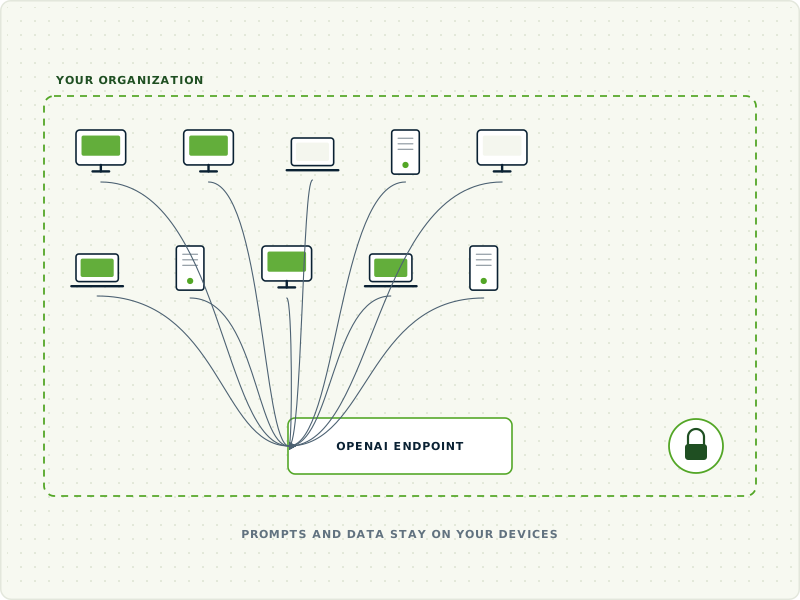
Salad Private Cloud deploys our orchestration stack inside your organization. It pools the GPUs already sitting in your workstations and servers, idle most of every day, into a private, OpenAI-compatible endpoint that serves tokens to your teams. Prompts, completions, and embeddings never leave company devices.
Single-tenant. Self-hosted control plane. The primary user of every device always has priority.
Enterprises pay for AI twice.
Once to cloud APIs, per million tokens, with usage growing faster than any budget planned for. And once for the GPU-equipped hardware already on the books, which sits idle every night, every weekend, and most of every working day. Private Cloud connects the two.
Token bills compound
Every employee now uses an LLM daily. Coding assistants, agents, RAG, and summarization turn into a line item that finance cannot forecast.
Data leaves the building
Prompts carry source code, customer records, and contracts to third-party endpoints. For regulated teams, that is the blocker to adoption.
Hardware sits idle
Workstation and server GPUs are utilized a fraction of the time they are powered. The capacity to serve most internal workloads is already paid for.
Five steps from idle fleet to private endpoint.
Install the control plane
Deploy Salad's orchestrator on infrastructure you control: a server in your data center, a VM in your cloud tenant, or a pre-built appliance.
Roll out the agent
A lightweight, sandboxed agent ships through your existing endpoint management (Intune, SCCM, or equivalent). Target by site, hardware class, or pilot group.
Detect idle, never intrude
The agent contributes GPU time only when the device is unattended or the GPU is unused, and yields instantly when the primary user needs it.
Pool and serve
Available GPUs are pooled into a private inference cluster behind an OpenAI-compatible endpoint. Run open-weight models or your own fine-tunes.
Govern and meter
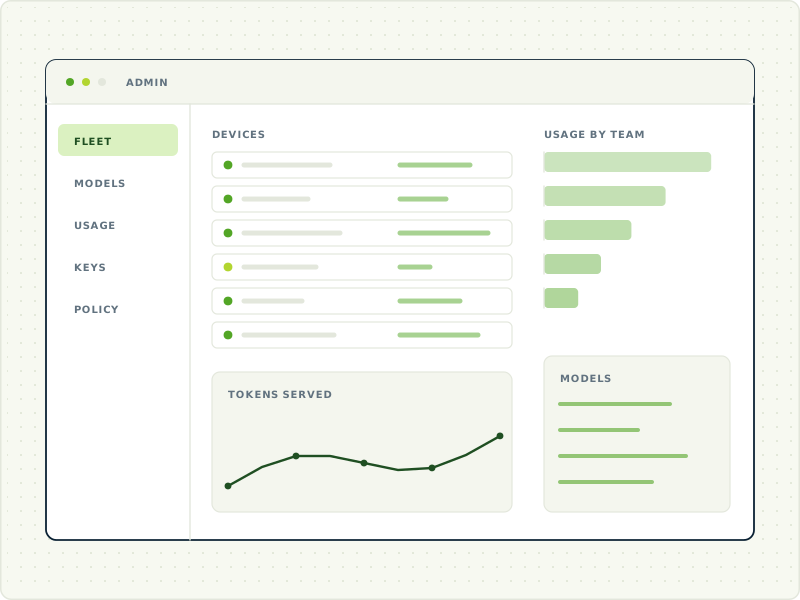
IT controls which users, applications, and departments reach which models, with rate limits. Audit logs and metering stay on-prem.
Everything that touches your data stays inside your network.
Apps, agents, assistants
Coding assistants, RAG, chat, internal tools. Any OpenAI SDK.
Private OpenAI-compatible API
Auth, routing by model and latency budget, rate limits, audit log.
Salad orchestrator, self-hosted
Schedules requests onto available GPUs. Meters usage. Health and trust scoring.
Agent on each device
Sandboxed runtime; no access to user files; contributes only when idle.
Your GPU fleet
Workstations, laptops with discrete GPUs, edge servers, lab machines.
Only operational telemetry (node health, utilization, version) is shared with Salad for support and licensing, and you can review exactly what. Model weights can be open (Llama, Qwen, Mistral, and others) or your own.
Four reasons IT and finance both sign.
Data sovereignty
Prompts, code, customer data, and embeddings never leave company-owned devices. Solves the first objection to enterprise LLM adoption.
Marginal cost of electricity
The hardware is depreciated and powered already. Serving tokens on it costs power, not per-token margin to a cloud vendor.
Unmetered access
Give every engineer, analyst, and support agent generous allowances without a procurement conversation for each new use case.
Use what you bought
Higher return on every workstation and server already on the books, and a smaller footprint than a new AI cluster.
Right-sized for the 99% of workloads.
Most enterprise LLM traffic is light and input-heavy: retrieval over internal documents, code completion, summarization, classification, embeddings, and agent steps. These run well on 8B–70B-class models across pooled workstation GPUs. For frontier-scale models or dedicated per-developer horsepower, pair Private Cloud with Salad Dedicated or purpose-built workstations.
- RAG over corporate documents and knowledge bases
- Code completion for every developer, not just a few
- Summarization, classification, extraction, and embeddings
- Internal chat assistants and departmental agents
- Batch processing overnight, when the fleet is fully idle
The orchestration we've run publicly since 2018, packaged single-tenant.
SaladCloud schedules containers onto hundreds of thousands of machines Salad has never touched, secures them with hypervisor isolation, and keeps production customers online through constant churn. Private Cloud is that same stack with one tenant, your network boundary, and your hardware.
Questions from IT.
What happens when someone sits down at their machine?
The agent yields immediately. The primary user always has priority; inference is scheduled onto other available devices. Users can also pause contribution manually, and IT can set contribution windows by group.
Does any of our data reach Salad?
No prompts, completions, embeddings, documents, or model weights leave your network. The control plane runs on your infrastructure. Salad receives operational telemetry only (health, utilization, versions) for support and licensing, and the exact fields are documented for your review.
Which devices qualify?
Windows workstations and servers with a supported NVIDIA GPU today, with additional platforms on the roadmap. Your endpoint inventory tells you the eligible fleet before you deploy anything; we will help you size it.
Which models can we run?
Open-weight models such as Llama, Qwen, and Mistral in production quantizations, plus your own fine-tunes. Model selection, quantization, and context limits are set per pool so quality is predictable.
How is it licensed?
Private Cloud is licensed per deployment and sized to your fleet, with implementation support from Salad engineers. Speak to sales for a scoping conversation.
Turn the fleet you own into the cloud you need.
Bring your device inventory and your top three LLM use cases. We'll size the pool and show you the economics.